Learning to Teach Online

Openo, J. (2019). Can (post-heroic) leadership be taught online? A library educator’s expansion of Baldwin, Ching, and Friesen’s grounded theory model of online course design and development. Journal of Education for Library and Information Science,…

Openo, J. (2019). Can (post-heroic) leadership be taught online? A library educator’s expansion of Baldwin, Ching, and Friesen’s grounded theory model of online course design and development. Journal of Education for Library and Information Science, (60)4, 354-372.

Online education continues its rapid expansion and evolution in Canada. For much of the first two decades of the 21st century, online education operated outside the formal structures of postsecondary.  But online education has now moved from the periphery to the core of the postsecondary mission, and all faculty need to have a basic level of competence with online learning technologies.

Because of a lack of universal reporting requirements and inconsistent reporting, much remains unknown about the current composition, preparation, and experience of online instructors in Canada.  What appears to be known, however, is that a majority of faculty who have taught online (77%) felt that teaching online provided deeper insight into the nature of teaching and learning in every setting.  It also appears that training and support for faculty is central to overcoming the primary barriers to the adoption of online education.

This article provides a brief overview of how I approached building an online course in the University of Alberta’s Graduate School of Library and Information Science three years ago. 

Instructional beliefs. When starting to teach online, many faculty bring their fears, inhibitions, and bewilderment to teaching in mediated and networked contexts.  The experience of teaching online can be a disruptive and disorienting dilemma for faculty that requires a reconsideration of one’s teacher identity and their belief systems. This is why a good first step before teaching online is unpacking our beliefs about what teaching and learning is. Faculty may possess unquestioned assumptions or unexamined beliefs about teaching.  Intentionally surfacing these assumptions and beliefs then informs the learning objectives, assessments, and how the course is organized.

Establish teaching presence early and often.  The Community of Inquiry framework is the most highly research theoretical model of online education, and one of the core elements of the Community of Inquiry framework is Teaching Presence, which consists of design, facilitation, and direction of a community of inquiry.  Design also includes assessments.  To build teaching presence, instructors can provide a welcome letter, brief videos, announcements, and feedback to ensure strong teaching presence.  In online settings, it is critical to design interactive experiences that incorporate frequent and substantive personal interactions.

Structure students for engagement. Teaching online requires a different set of skills than delivering content, and intentional thought needs to be spent on structuring students for maximum engagement.  Many online instructors find discussion boards uninspiring. Discussion boards are only one way to get engaged interaction with and between students.  Collaborative projects, peer assessment, debates, brainstorming activities and learner-developed and directed questions provide alternatives to uninspired discussion boards. Learner-generated questions and learner-facilitated discussion can serve as mechanisms for learners to refine their ideas and promote group reflection (Blaschke, 2012).  Collaborative learning can also serve as the primary method for students to practice essential self-management skills, such as communication, task negotiation, emotional intelligence, and decision-making, as well as demonstrating personal responsibility. 

Go beyond the LMS. Jon Dron (2017) at Athabasca University puts in candidly, “the learning management system alone will not take us where we need to be.”  Building a learning environment that goes beyond the LMS flows from one’s instructional beliefs, activities, and the course goals.  Reflective journals, blogs, wikis, concept mapping software, and apps such as Padlet or Remind can all be used to supplement and transcend the limitations of the LMS.  Some instructors use Twitter to great effect in teaching micro-writing, but consideration must be given to the necessity/value of walled or open systems.

Reflect and modify.  No course design is perfect the first time around (or the 20th time around).  Keep a journal that records what worked and what could be changed or improved. Review the course analytics and learner comments (which are rarely straightforward to understand and take action on).  Then activate your intuition and judgement. Revise your teaching beliefs, if necessary, adapt the course design, and improvise.

I have heard a quote, mis-attributed to Einstein, that the highest form of research is essentially play. In technology circles, too, play is the highest form of proficiency. Some people react strongly and negatively to the idea of play when it comes to teaching, but teaching online successfully requires a serious level of play. It is possible, after all, to have quite a bit of fun with it.
CRAM in Open Education Week

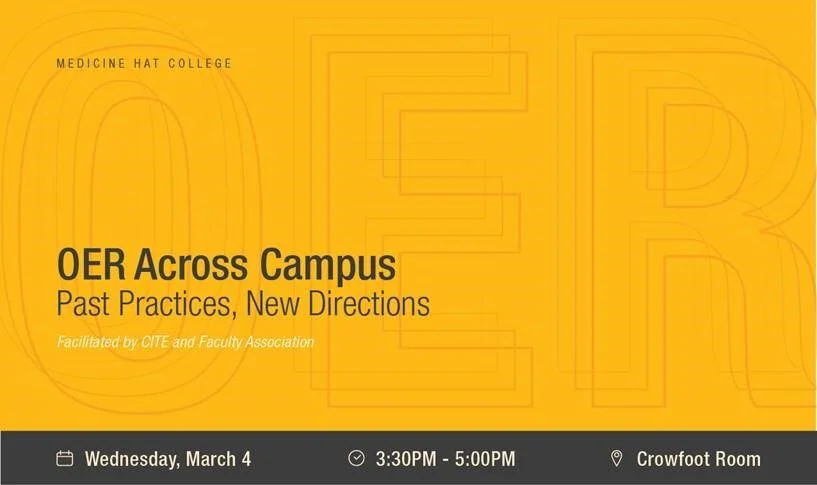
OER Across Campus.jpg

This year, to celebrate Open Education Week, MHC’s Faculty Association, the Centre for Innovation and Teaching Excellence, the VPA office and MHC’s bookstore are hosting a panel to talk about Open Educational Resources and the Canadian Roundtable on Academic Materials.

In December 2019, representatives from across the college (including faculty) assembled to talk about a future textbook strategy.  This was the second meeting to discuss how MHC can lower the costs for the students and look at alternative methods of providing course materials.  This conversation was a microcosm of an ongoing national conversation now taking place as the Canadian Roundtable on Academic Materials (CRAM).

Faculty members are (and always will be) in the best position to affect the prices of textbooks, but there are other players involved, and the history of CRAM illuminates this.  CRAM was founded in 2007 at the University of Alberta as a partnership between the Bookstore and Student’s Union.  These two entities often see the issue of textbook costs from different perspectives.  Bookstores may feel the pressure to produce revenue, whereas the Student’s Union will see textbook costs in terms of student debt and student stress. 

At the college level, especially, it appears that whatever money students save on textbooks, they use to invest in their education.

The Canadian Roundtable on Academic Materials began a national dialogue centered on a collaborative effort to primarily address the high cost of course materials.  Campus Stores Canada re-initiated this conversation in October 2018 at Ottawa’s Lord Elgin Hotel.  The key parties involved in the ongoing conversations taking place between Fall 2019 and Spring 2021 included faculty (Canadian Association of University Teachers), librarians (Canadian Association of Research Libraries), educational developers (Society of Teaching and Learning in Higher Education), administrators (Universities Canada), and Campus Stores Canada (the association representing collegiate bookstores).

In CRAM’s 2018 report capturing these conversations, they note a relationship between course material affordability and student mental health.  Student well-being has the potential to be the bridge as this is a shared value for all stakeholders.  Libraries and bookstores also seemingly hold competing mandates, but collaboration between these entities can enhance the student experience.  Faculty may not be aware of the full range of choices available to them via OER or the library’s collections.  Students will buy textbooks that have perceived value, and they prefer print, but will purchase digital if it’s more affordable.  Most importantly, it is important for all stakeholders to work together. That’s why I am excited about this event next week on March 4.

CRAM’s 9 key principles represent this spirit of collaboration and conversation.  They strive to achieve the goal “to ensure the existence of an ongoing medium through which the key parties can identify and implement ways of addressing the underlying issues.”  Some of the nine principles include:

·         Academic materials must be a high quality and offer reasonable value to students.

·         Academic Community Members are the ultimate decision makers for selecting academic materials.

·         Academic Community Members should consider the cost for students when selecting course materials, and should explore and utilize the most cost-effective forms of delivery.

·         The academic materials delivery processes at each participating school should incorporate joint Bookstore, Student, Academic Community Members and Library committees that foster communication, promote enhanced relationships, and facilitate the sharing of ideas and concerns.

·         Establish monitoring and feedback mechanisms in order to measure and enhance the quality, affordability, and accessibility of academic materials.

·         Advance the cost-effectiveness and affordability of academic materials through the development of advocacy strategies and tools that can be utilized at the campus level to promote enhanced awareness of the problems and the solutions.

It’s an important time to have this conversation. We are not exactly sure what Performance-Based Funding will look like in Alberta, but Open Educational Resources appear to be a metric not tied to funding. More importantly, most faculty (where choice exists) think about what is in the best interests of students when selecting their learning materials, and it will be good to get a sense of where supports can be effective.  

"Are we becoming what we want to become?"

Dublin is a city undergoing rapid technological transformation as Ireland strives to become a tech-hub of Europe, including educational technology.

Dublin is a city undergoing rapid technological transformation as Ireland strives to become a tech-hub of Europe, including educational technology.

I recently presented a paper at the World Conference for Online Learning in Dublin, Ireland.  The theme for the conference was “Transforming Lives and Societies,” and the best part of the conference was listening to critical voices seeking to understand how lives and societies are being transformed, why, and what are the long-term implications of these transformations?  Perhaps my favourite was closing plenary speaker Dr. George Siemens; Dr. Siemens was my research methods instructor at Athabasca University and one of the reasons I chose the Athabasca program.  In a fairly popular blog post from 2015 entitled “Adios Ed Tech. Hola something else,” Dr. Siemens announced a personal transformation:

It’s time for a change. A curious disconnect has been emerging in my thinking, one that has been made clear with the hype-oriented buzzwords of today’s edtech companies. I no longer want to be affiliated with the tool-fetish of edtech. It’s time to say adios to technosolutionism that recreates people as agents within a programmed infrastructure.

In his plenary, Dr. Siemens asked if technology is helping us to become what we want to become?

It certainly is for Ireland.  Ireland’s Minister of State for Higher Education, Mary Mitchell O’Connor, clearly stated Ireland’s aspirations to become the “tech capital of Europe, and that includes educational technology.” In many respects, Ireland already is a tech-hub with headquarters for Google, Ancestry.com, LinkedIn, Facebook, and the National Institute for Digital Learning.  And, as it is with most online learning conferences, this one was also full of optimism and excitement for the future of educational technology.

Here are, in no particular order, snippets of key takeaways that I jotted down in my learning journal from the many dialogues of transformation taking place at the World Conference for Online Learning (I wish I would have done a better job of writing down names):

  • Students have to be at the epicenter of all decisions about online education. This includes synchronous support – live calls because relationships with students are important.

  • It may also include a “regulatory environment” that supports the use of technology to supplement and strengthen the intrinsically interactive nature of teaching and learning. Courses and programs must consistently incorporate the frequent and substantive personal interaction that is central to the learning process.

  • Online education requires a redefinition of our understanding of teaching and learning. It is neither Sage on the Stage nor Guide on the Side.  “Universities must evolve their paradigm, from student to learner, from teaching to designing and managing learning experiences, from degree based to continuous learning.”

  • Everyone is striving to think beyond the 18-24 year old demographic and beginning to think into genuine lifelong learning.  Upskilling is the future of education; 30-50% of adult learners will need to be reskilled during their careers.

  • Credentials are the core business of education.  Alternative digital credentials potentially mean less time to spend, and less bills to pay.  "Universities and colleges that fail to adopt the Alternative Digital Credential movement will experience a slow decline in relevance and market position.”

  • "It is a precious thing to have a job. After all, we all have jobs, whether you think that's the primary role of education or not."

  • There are a lot of quality assurance frameworks in online education, but all are little used – institutions have to use a credible framework, modify an existing one, or develop their own.

  • Our current assessment system (grades) undermines all attempts at learning.

  • “We need to put forth collective effort to better understand and address the challenging conflicts in online higher education contexts to make openness and innovation authentic dialogues rather than just rhetoric.”

Dr. Siemens, in his closing remarks, admitted he was less interested in what is changing and how it is changing. Instead, he is increasingly interested in whether technology is helping us become what we want to become.  And to become what we want to become, we have to stop creating problems that only new technology can solve. We will also have to acknowledge systemic problems and resolve those, not with technology, but with human morals, values, and principles.

Microcredentials: Future or Fantasy?

My digital badge from Educause is integrated with my LinkedIn account. Who cares?

My digital badge from Educause is integrated with my LinkedIn account. Who cares?

I had the chance to talk to the AB Deans of Business about microcredentials, which I then turned into a short article for MHC’s monthly, called The FAX.

Much has been made of micro-credentials, but are they the future, or are they just fantasy?  In short, micro-credentialing is a way to recognize competencies or skills acquired through a wide variety of learning experiences, including international experiences, community-service learning projects, and short courses.  The micro-credential is often represented by a digital badge, or an icon that includes metadata on who issued the badge, when it was issued, and the criteria and/or evidence for earning the credential.  A user can share the micro-credential as part of an integrated method for demonstrating their learning in ways beyond just formal coursework and the transcript (Taylor Institute for Teaching and Learning, 2017).

Microcredentials and digital badges are easy enough to create, but the big question is who values them?

The opportunity exists for badges to find their place in postsecondary education, but just because you can develop a digital badge or microcredential, that does not mean it has any value. The value may come from the ability to break learning down into chunks, or providing some evidence of skills that are harder to demonstrate, such as communication skills. Even though claims of change are rampant, microcredentials have not yet had much impact.

As Dianne Conrad and I wrote in our book (Conrad & Openo, 2018), my favorite example of the successful deployment of micro-credentials comes from a hands-on undergraduate chemistry course.  Students earned badges in the proper use of lab equipment. In the videos that learners submitted for assessment, students stated their names, showed their face and hands, and then did a task, such as performing a close-up shot of a calibration mark on lab equipment.  Mid-semester examinations on how to use the equipment demonstrated that between 74% and 95% of students who received their laboratory badges answered laboratory use questions correctly.  At the same time, the department saved $3,200 in equipment costs—two very different ways to prove that students had more effectively mastered the learning outcomes of safely and effectively using lab equipment.

What is the lesson here? As the use of digital badges increases, it may become clear when and where they are most effective in influencing student engagement and motivation.  It’s unlikely that badges are going to replace the parchment any time soon, but perhaps there are specific cases (new graduates, evidence of soft skills, or experiential learning opportunities) where micro-credentials make sense (Selingo, 2017).

Casilli and Hickey (2016) put forth two strong arguments indicating that badges might become a more prominent feature on the assessment landscape. The first is that digital badges provide an opportunity for schools to generate more claims of student learning, with more evidence to support those claims. Secondly, digital badges increase the transparency of assessment practice, and through the transparency of badges—which includes metadata, assessments, and artifacts—it is possible that the importance of conventional forms of recording learner performance, for example, transcripts, where there is no supporting evidence of student learning, may diminish. Or a blockchain verified transcript might be enhanced through the integration of the transcript, attendant micro-credentials, and evidence of learning from a student’s e-portfolio.

Maybe. Maybe not.  Micro-credentialing is not a new idea, but there are some new approaches emerging. Wilfrid Laurier is now using a tracking tool to capture students’ experiential learning experiences, and the University of Alberta awards a Community-Service Learning Certificate as part of a student’s co-curricular record.  These are good examples, but significant challenges remain.

First off, micro-credentials haven’t gained acceptance in work or academic worlds, so they need to evolve and mature (Harvey, 2017).  Plus, not all degrees are created equal. Sometimes, institutional prestige determines the signal value of the parchment.  In areas where you need a specific credential to practice (Registered Nurse, for example), micro-credentials won’t do you a lot of good (Duque, 2018).  And a remaining problem is coming up with rigorous and reliable measure that someone has achieved the competency specified for the badge (Greene, 2019).  This takes us back to perennial problem of assessment in general; what proof do we have that learners have actually acquired any of the knowledge, skills, or values we claimed they have?

So here is my not so bold prediction:  some institutions are going to continue to play and experiment with micro-credentials because of increasing pressure on postsecondary institutions to provide evidence of learning, which will increasingly be tied to funding and performance-based outcomes.  They will also continue to play and experiment with micro-credentials as a new business model.  Incredibly prestigious and well-resourced universities (Cambridge, Harvard, and MIT) are all working to figure how achieve scalable modularity, and I suspect someone will eventually figure out a model that works. Arizona State University’s Global Freshman University (a micro-Bachelors) failed, but it might end up being a failure in the right direction.

References

Casilli, C., & Hickey, D. (2016). Transcending conventional credentialing and assessment paradigms with information-rich digital badges. Information Society, 32(2), 117–129. doi:10.1080/01972243.2016.1130500

Conrad, D., & Openo, J. (in press).  Assessment strategies for online contexts: Engagement and authenticity. Edmonton, AB: Athabasca University Press.

Duque, C. T. (2018, September 21). No one has figured out successful, sustainable microcredentialing. LMS Pulse. Retrieved from https://www.lmspulse.com/2018/no-one-has-figured-out-succesful-sustainable-microcredentialing/

Greene, P. (2019, February 16). Education micro-credentials 101: Why do we need badges? Forbes. Retrieved from https://www.forbes.com/sites/petergreene/2019/02/16/education-micro-credentials-101-why-do-we-need-badges/#30b808424190

Harvey, D. (2017, November 12). Micro-credentials: Fad or skills training disruption? LinkedIn.  Retrieved from https://www.linkedin.com/pulse/micro-credentials-fad-skills-training-disruption-david-harvey/

Selingo, J. J. (2017). The Future of the Degree: How Colleges Can Survive the New Credential Economy. Washington, DC: The Chronicle of Higher Education.

Taylor Institute for Teaching and Learning. (2017). UCalgary badges. Retrieved from https://badges.ucalgary.ca/.

The Real World of Technology Re-Visited

In May, I had the privilege and honour to present a session at Mount Royal University’s Liberal Education conference. https://www.liberaleducation.ca/

In May, I had the privilege and honour to present a session at Mount Royal University’s Liberal Education conference. https://www.liberaleducation.ca/

My presentation was a 30-year retrospective on Ursula Franklin’s The Real World of Technology. Franklinewas prescient.

Franklin suggests that technology tends to displace the human and transform the nature of experience.  As technology displaces human muscle and human mind and alleviates the shortcomings of being human, the human is not so much enhanced as much as it is minimized. Franklin says,

As more and more of daily life in the real world of technology is conducted via prescriptive technologies, the logic of technology begins to overpower and displace other types of social logic, such as the logic of compassion or the logic of obligation, the logic of ecological survival or the logic of linkages to nature.

This is not just polemic. A good example of this overpowering displacement is that when, in 2007 the Oxford Junior Dictionary was published — a sharp-eyed reader noticed that around forty common words concerning nature had been dropped. Apparently they were no longer being used enough by children to merit their place in the dictionary. The list of these “lost words” included acorn, adder, bluebell, dandelion, fern, heron, kingfisher, newt, otter, and willow.  Among the words taking their place were attachment, blog, broadband, bullet-point, cut-and-paste, and voice-mail.

Franklin suggests we need to consider machines and devices as cohabitants on this earth, and in Simon Winchester’s The Perfectionists, he writes, “The numbers are beyond incredible. There are now more transistors at work on this planet (some 15 quintillion) than there are leaves on all the trees in the world.” This is the overpowering and displacing effect of technology.

Liberal education is also being overpowered and displaced.  Throughout this symposium, several presenters suggested that automation and liberal education can play nicely with one another.  If they can, it will only be to the extent that liberal education serves the logic of technology.  If more examples and events like this cannot be accomplished to question the logic of technology and its displacing effect, Franklin warns that the house that technology built will not become anything more than an unlivable techno-dump.  Franklin says, “I have long subscribed to what I call Franklin’s earthworm theory of social change. Social change will not come to us like an avalanche down the mountain. Social change will come through seeds growing in well prepared soil – and it is we, like the earthworms, who prepare the soil.” 

My fellow worms, let us thank MRU and MHC for preparing the soil.

Words
SLides

Medicine Hat College Wins EBSCO Solar Grant

EBSCO Solar.JPG

Medicine Hat College in Medicine Hat, Alberta, Canada, has recently embarked on several innovation projects in the renewable energy sector with the intent of providing students, faculty and the community an opportunity to learn about emerging technologies. Currently, the post-secondary institution has a micro grid at its Medicine Hat campus that includes an electric vehicle charging station, solar panels and wind turbines. Recognizing the growing opportunity in this industry, the college is providing learners a chance to broaden their skills, so they are prepared for tomorrow’s workplace. The EBSCO grant will allow Medicine Hat College to expand its investment and continue its research into renewables at the Brooks campus.

The EBSCO Solar grant will provide the college an opportunity to showcase a creative and functional solar ‘garden’ that will educate students, residents and businesses in the region on how to effectively implement the use of alternative resources. The project will be incorporated into the natural landscape with the help of Built Environment Engineering Technologies and Trades students. Jason Openo, Director of Teaching and Learning at Medicine Hat College Library, says, “I am most excited about the opportunity this grant provides to our Built Environment Engineering students, who will have an authentic learning experience in designing and constructing for the library a beautiful, solar-powered classroom and community space. This literally equips them with the skills necessary to build a new future for our community and our province.”

https://www.ebsco.com/news-center/press-releases/ebsco-information-services-announces-2019-ebsco-solar-grant-winners

Absolutely thrilled to be have been part of this project. My role was to pull the right people together. So blessed to work with a group of talented and committed people.

The International Dimension of Academic Integrity: An Integrative Literature Review

Canadian Symposium on Academic Integrity.PNG

Over half a million international students now study in Canada. This rapid increase in international enrollments has intensified focus on academic integrity because the stakes are high for both international students and the institutions that host them. Academic integrity violations involving international students may garner scandalous attention, and the international students who become entangled in incidents of academic misconduct face potentially devastating life consequences, including expulsion from academic studies and dishonor in family life. International students studying in Canada, particularly those whose first language is not English, face several hurdles not experienced by their Canadian counterparts. Overcoming these cultural barriers is a shared interest and a top strategic priority because academic credentials are a signal that assert students have mastered academic norms of the new culture. There remains considerable debate surrounding international students regarding their increased likelihood to commit academic integrity violations, and this integrative literature review explores the intersection of academic integrity and international students. It takes a broad and holistic approach to identify areas of conflict and knowledge gaps, with a focus on successful institutional interventions that proactively reduce the likelihood of academic misconduct. Little research details efficacious methods to reduce incidents of academic integrity violations involving international students, but taking stock of current interventions provides some guidance to institutions welcoming international students, and the faculty who teach them, so that they can both be successful in addressing academic integrity issues.

Paper
Slides

Assessment blues: How authentic assessments saved my teaching soul

Openo, J. (2018). Assessment blues: How authentic assessments saved my teaching soul. Journal for Research and Practice in College Teaching, 3(2), 171-174. Retrieved from https://journals.uc.edu/index.php/jrpct/article/view/908/816

Openo, J. (2018). Assessment blues: How authentic assessments saved my teaching soul. Journal for Research and Practice in College Teaching, 3(2), 171-174. Retrieved from https://journals.uc.edu/index.php/jrpct/article/view/908/816

Abstract

I was either going to quit teaching or I was going to make assessment mean something to me. My interest in creating engaging and meaningful assessments did not start with students, it arose from my desire to stop the stultifying process of inviting meaningless student work (that I had assigned!). I was, after all, ultimately responsible for doing this to them and to me.  Authentic assessments are the answer.  Authentic assessments are ill-defined and open-ended tasks that provide opportunities for students to apply their learning on real-world problems relevant to their discipline (Conrad & Openo, 2018). Students work collaboratively and practice communication, problem solving, self-management and teamwork in mastering course content. I didn’t know about authentic assessments when I first started instructing, but that’s the direction I headed in instinctually.

Full-text

The international dimension of academic integrity: An integrative literature review

I am presenting a session at the sold-out Canadian Symposium on Academic Integrity next week. Here is the abstract and the integrated model that my brilliant graphic designer Andrea Woods came up with.

Abstract

Over half a million international students now study in Canada.  This rapid increase in international enrollments has intensified focus on academic integrity because the stakes are high for both international students and the institutions that host them.  Academic integrity violations involving international students may garner scandalous attention, and the international students who become entangled in incidents of academic misconduct face potentially devastating life consequences, including expulsion from academic studies and dishonor in family life.  International students studying in Canada, particularly those whose first language is not English, face several hurdles not experienced by their Canadian counterparts.  Overcoming these cultural barriers is a shared interest and a top strategic priority because academic credentials are a signal that assert students have mastered academic norms of the new culture.  There remains considerable debate surrounding international students regarding their increased likelihood to commit academic integrity violations, and this integrative literature review explores the intersection of academic integrity and international students.  It takes a broad and holistic approach to identify areas of conflict and knowledge gaps, with a focus on successful institutional interventions that proactively reduce the likelihood of academic misconduct.  Little research details efficacious methods to reduce incidents of academic integrity violations involving international students, but taking stock of current interventions provides some guidance to institutions welcoming international students, and the faculty who teach them, so that they can both be successful in addressing academic integrity issues. 

To cheat or not to cheat? This integrated model outlines the research-based reasons why students choose to commit or not commit academic integrity violations. Most have some theoretical correlation. International students face intensified pressures …

To cheat or not to cheat? This integrated model outlines the research-based reasons why students choose to commit or not commit academic integrity violations. Most have some theoretical correlation. International students face intensified pressures around success, rewards to be gained (permanent residency), and social norms (some may come from countries where corruption is commonplace). Conversely, some international students may have stronger ethical beliefs related to respect for authority.