The Right Relationship Between Teaching and Ed Tech

My dissertation was a mess. My committee chair said to me as gently as she could, “there are a lot of moving parts going in a bunch of different directions.” I was lost and didn’t see a way forward.

On a rainy day in 2018, my wife and I took shelter in Russel’s Books in Victoria. I stumbled upon Ursula Franklin’s The Real World of Technology and read it standing in the store. Suddenly, I could see the finish line for what I was trying to do. The shelving within my brain was reorganized according to Franklin’s multiple realities (which became the title of my dissertation), which provided the theoretical framework necessary for me to articulate what I wanted to see, and how I might be able to see the invisible. This article grew out of that immersion in Franklin’s thought, and it explores wrong relationship between technology and teaching in postsecondary contexts, and it gives some guidance for how the Scholarship of Teaching and Learning can serve as a redemptive technology.

Very glad to see this tribute to Ursula Franklin finally come to life.

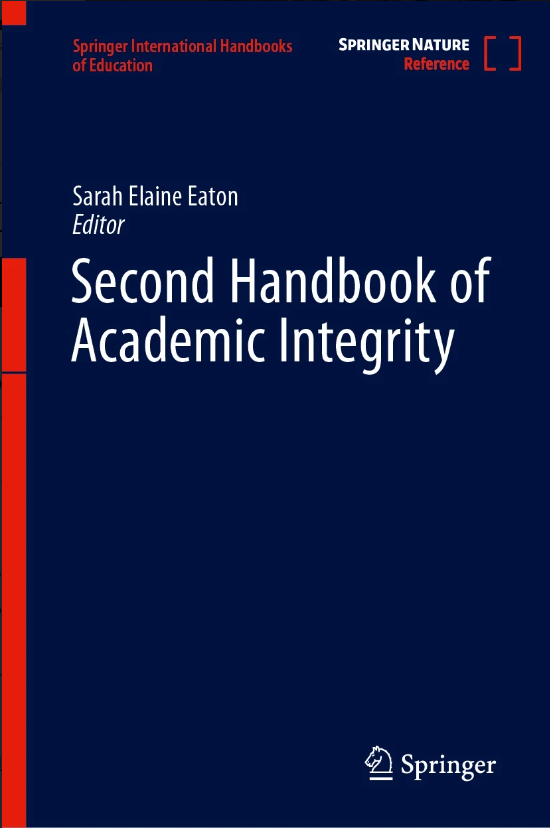
Second Handbook of Academic Integrity

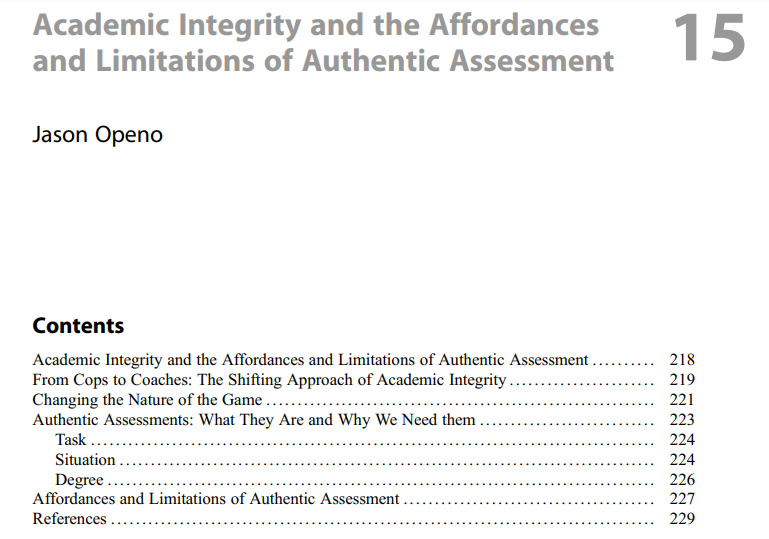
With 112 chapters and just about 2,000 pages written by a diverse array of global authors, this is THE definitive resource exploring the various aspects of academic integrity in the contemporary postsecondary environment. I am thrilled to be part of Dr. Sarah Elaine Eaton’s project with my chapter in Part II - Academic Integrity Through Ethical Teaching and Assessment, edited by Dr. Brenda Stoesz. My chapter is entitled Academic Integrity and the Affordances and Limitations of Authentic Assessment.

Available at: https://link.springer.com/referencework/10.1007/978-3-031-54144-5

The thesis of my chapter is far from groundbreaking. More engaging and authentic assessments can neutralize (to some degree) the inclination for students to commit academic integrity violations. The sub-thesis is that better assessments can certainly help, but there are structural limitations that inhibit change. Postsecondary education is an ecosystem under stress, and this stress can inspire and crush pedagogical innovation at the same time, depending on the local institutional context.

Some have written that authenticity has not been well conceived. I believe my body of work contributes to this from two different lenses.

First, the lens of authenticity derived from Patrician Cranton and Ellen Carrusetta - who is our authentic teaching self? The best and most effective assessments have to be authentically aligned to our teaching identity and our educational values.

Second, authenticity is gauged by the degree to which real-world tasks take place in professional contexts and situations. This is an ideal that is often impossible to meet within the limitations of an educational setting, but instructors can often get closer than their current assessments afford.

I am not sure how much more I will have to say on academic integrity and/or authentic assessment. I am fascinated by both, but I’ve been writing on this for almost a decade now, and my research and writing interests are shifting in other directions. Still, based on the work I have done in both assessment and academic integrity, I think my work will remain relevant for the foreseeable future because assessment is slow to change, but the underlying principles provide a sound foundation for assessment design with technology.

Mixed feelings: A preliminary look at student reactions to using ChatGPT for academic purposes in a business course

On November 24, my friend and colleague Rick Robinson and I facilitated a conversation at Mount Royal University’s 2023 SoTL Symposium - Expeditions in SoTL.

Since its public launch in November of 2022, ChatGPT 3 has dominated postsecondary news and discussions. Faculty are split in their reaction; some describe it as a disruptive force and are afraid of how it will impact their assessments, whereas others see it as an opportunity to aid student learning. 

Because ChatGPT is freely available, produces high quality outputs, and will likely remain ahead of detection tools, the best approach may be to adopt the use of AI technology in learning and assessment strategies (Halaweh, 2023; Mollick & Mollick, 2022). In addition, Strzelecki, (2023) points out that students’ perception of adopting new technologies is crucial. In this preliminary study, faculty intentionally encouraged the use of ChatGPT in a business assignment. Part of the assignment asked students to voluntarily reflect on their experience using ChatGPT for business purposes.

This roundtable discussion shared student reactions on using ChatGPT in an academic setting, including anger, excitement, and anxiety. This small set of reflections highlights the need for more research into the student experience of using ChatGPT for academic purposes, the importance of teaching strategic thinking, and the need for specific technology-related learning outcomes in business programs.

As automation augments and transforms the nature of work, using tools like ChatGPT will be an important technical skill in some settings. In all likelihood, working with artificial intelligence will form an important part of students’ professional life, and students need to understand the increasingly technological world in which they live (Perkins et al., 2023). The roundtable discussion encouraged participants to share their assessment approaches and consider how ChatGPT can be integrated in ways that build human capacity for an emerging real-world where use of large language models will be commonplace.

Rick and I transcribed the conversation and are working on a piece for inclusion in the conference proceedings.

Problematizing OER

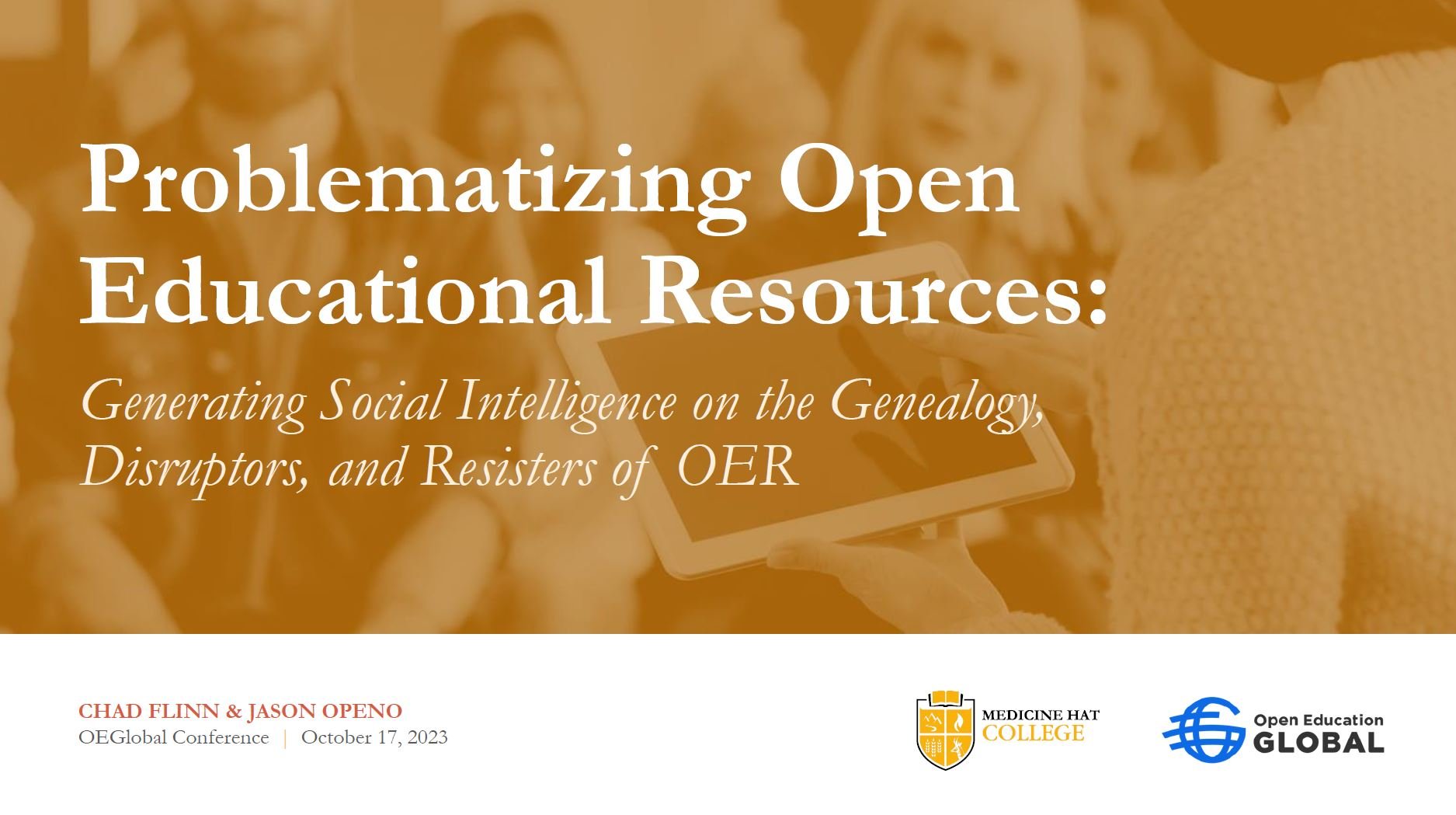
On October 17, Chad Flinn and I facilitated a great conversation at OE Global in Edmonton.

This session offered series of conversations on the genealogy and disruption of OER using Bacchi’s WPR approach (What is the problem represented to be?). Social intelligence arises from lived experience under conditions of unalterable changefulness (such as the progression of educational technology, the intensification of marketization, and the pandemic) to find new opportunities to exploit cracks and fissures in structurally entrenched forms of power. This conversation engaged participants in a collaborative, multi-level dialogue of the historical and philosophical origins of Open Educational Resources (OER), the disruptors and resisters within the OER movement, and the ways in which OER has (or has not) disrupted the current understanding of educational challenges and solutions.

The OER community of practitioners can, in one respect, be seen as a social-political movement. OER represent a political movement that has emerged under conditions of structural stability and social connectedness, but a common feature of social movements is its oppositional or alternative nature. But for the past two decades, OER advocates have accomplished high profile successes, achieved mainstream legitimacy, and extraordinary growth. OER are no longer a fringe or marginal phenomenon, but in an evolving and more mature phase, what is OER disrupting and opposing?

The first movement in the session problematized the concept of OER by discussing the educational challenges OER is designed to address. Participants were asked to consider and discuss:

How do you perceive the problems OER aims to address in your educational context?

Are there any aspects of the current educational landscape you believe OER overlooks?

The second dialogue explored the genealogy of OER by considering the historical development and philosophical underpinnings of OER. Dialogue questions included:

How have OER's historical and philosophical origins shaped the current understanding?

Are there any critical milestones or thinkers significantly impacting the OER movement?

The third movement considered disruptors within the OER movement. Participants discussed the roles and motivations of disruptors, such as challenging traditional educational models and practices, promoting open access and democratization of knowledge, and encouraging innovation in teaching and learning.

The fourth and final move of the conversation pivoted to examine resistors and forms of resistance, including the protection of intellectual property rights, Traditional Knowledge Labels, copyright concerns, preserving the status quo in educational institutions and systems, and addressing concerns about the quality and sustainability of OER.

Chad and I have drafted an article submitted to IRRODL for review, and we are hopeful the conversation and our reflections will be published soon.

Authentic Assessment for Online Learning - 2nd offering

I am excited to work with the Commonwealth of Learning to offer this MOOC for the second time. The course has reached over 4,500 learners from around the globe who are interested in initiating educational reform through improved assessment practice.

One of the ways I have worked to establish and maintain an instructional presence in this MOOC with over 2,000 learners is through daily announcements derived from discussions in the forums. This question was foundational.

Today’s question of the day is: How different is online assessment from traditional assessment?

There are 2 ways to answer this question – the long way or the short way. Here is the short way.

The answer depends on how we interpret “traditional assessment?” Traditional has become, for some, a bad word – meaning old and outdated. I interpret traditional in this question to mean at the same time (synchronous) and in the same place (location). Proctored exams and in-person presentations are two examples of “traditional” assessments where the students and instructor are in the same place at the same time. Internet-based communications technologies enable teaching and learning to transcend time and space limitations; people don’t need to lug their guts from one place to another for learning to occur.

But, you might rightly ask, what about research papers? Research papers are popular traditional assessments completed asynchronously and at a distance, when the instructor and the student were not in the same place at the same time. This is where it gets messy.  

Here is the long answer:  

Bates (2005) notes, “distance learning can exist without online learning and online learning is not necessarily distance learning (pp. 14-15).” Some distance learning formats still exist that do not employ the use of internet-based communications technologies. Bates (2017) captures the endemic definitional quagmire of online education by saying, “We are trying to describe a very dynamic and fast-changing phenomenon, and the terminology often struggles to keep up with the reality of what’s happening.” This observation took on new poignancy during the COVID-19 pandemic with the rise of phrases such as emergency remote instruction, bichronous, polysynchronous, and hyflex learning models.

Online education may include synchronous “face-to-face” technologies such as Blackboard Collaborate Ultra, Zoom, or Google Meet, asynchronous or multi-synchronous platforms such as the learning management system (LMS) and Google Docs, and/or participatory flow technologies such as Twitter, Facebook, and Padlet. The use of online education in this course denotes learning experiences where students and faculty use “a personal computer or other mobile device connected to the Worldwide Web using either a cable or wireless protocol,” and where faculty and students possess “the ability to make use of text-based, audio, and audio-visual communications that afford instructors the opportunity to create multifaceted and multidimensional instructional delivery systems” (Conrad & Openo, 2018, p. 8).

Because of these sophisticated instructional models, online assessments have an additional burden to be:

  • Intentional – Assessment is a major teaching and learning activity. How do online assessments provide evidence of learning outcomes?

  • Relevant – Online learners need to remain motivated and focused, and online assessments need to focus students' attention on the learning.

  • Creative – There are a plethora of tools available, and encouraging students to use these various tools can increase engagement.

Now, shouldn’t all assessments be intentional, relevant, and invite creativity? Yes. Because of the learning management system, aren’t all instructors teaching online to some extent now? Yes. So how different is online? Beyond the use of internet-based communications technologies, it's hard to say what’s unique about online assessment and what is just good teaching practice. But when online, instructors must pay closer attention to the affordances of technology and its limitations.   

Labour Market Skills Gap SE Alberta

Some years ago, I read Barbara Ehrenreich’s Nickel & Dimed: On Not Getting By in America. One of Ehrenreich’s major arguments is that there is no such thing as unskilled labour. Whether it is digging a trench or memorizing hundreds of produce codes, every job requires technical skill. My dissertation is ultimately about how increasing expenditures on educational technology over the last 30 years have transformed the professoriate. Displacing full-time faculty and replacing them with part-time faculty has been a cost containment strategy where technology has pushed out human labour. Whether part-time or full-time, however, all faculty must now possess an even more sophisticated skillset to teach with a proliferation of technological tools and teaching processes.

This report, which sought to understand technical skills, is a Herculean endeavor. It was great to lead a wonderfully talented group of individuals to explore the unique (and not-so-unique) challenges we face as a community.

Global Trends

Over the past 50 years, the share of jobs requiring at least some college education has increased dramatically, and the fastest-growing sectors of the economy are projected to be those jobs requiring new skills driven by advances in technology (Carnevale, 2016). Shifts in technology render some jobs obsolete at the same time these advances create new jobs (Latchem, 2017). This transformation in work includes a shift from high-risk, low-mobility occupations to career pathways in rapid-growth occupations in the clean economy (Sonmez, et al., 2022). Even though technology will eliminate some jobs and create entirely new occupations, the need for talented human beings with truly human skills remains.

Frey and Osborne (2017) identified three sets of tasks that cannot be easily automated, including:

  • Unstructured and complex tasks;

  • Tasks requiring creative intelligence;

  • Tasks related to social intelligence, such as understanding people’s reactions in social contexts or assisting and caring for others.

Strategy, creativity, and compassion will remain important skills no matter how technology advances and transforms the nature of work. Still, the impact of technology on existing and emerging occupations, coupled with the enduring need for human skills, suggests that the region needs a new model of skills and skills acquisition that enables learners to understand the highly technological world around them while nurturing the uniquely human capacities for creativity and flexibility (Aoun, 2017).

National Trends

In Canada, 42% of existing jobs, primarily in manufacturing, agriculture, and the service sector, are either highly automatable or will face substantial change in the coming years (Organization for Economic Cooperation and Development, 2018). In addition to advances in technology, significant shifts in energy markets will also give rise to new careers and make others obsolete (Sonmez, et al., 2022). It is expected that 40 percent of all new jobs will be in the skilled trades and technology (Little, 2017), indicating a pressing need to develop a better understanding of the new technical skills demanded by a more sophisticated job market.

Academic Integrity and the Affordances and Limitations of Authentic Assessment

https://link.springer.com/referenceworkentry/10.1007/978-981-287-079-7_90-1

I am very proud of the following publication.

Openo, J. (2023). Academic Integrity and the Affordances and Limitations of Authentic Assessment. In: Eaton, S.E. (eds) Handbook of Academic Integrity. Springer, Singapore. https://doi.org/10.1007/978-981-287-079-7_90-1

ABSTRACT

Academic integrity presents a perennial and long-standing challenge to postsecondary education. Outsourcing academic activity through contract cheating undermines academic credentials and potentially puts people at risk through extended professional incompetence. Postsecondary institutions must take the threat of academic dishonesty seriously, but to do so, faculty are often presented with the stark choice of playing a game of cops and robbers by increasing surveillance in the form of online proctoring. The rise of contract cheating, outsourcing of student work, and dissatisfaction with online proctoring have heightened focus on the teaching and learning environment and how changing the nature of student assessments can change student behavior. This chapter explores the concept of authentic assessments and argues that authentic assessments can play an important role in creating an academic culture of integrity. It provides guidance for thinking about why authentic assessments are needed now more than ever, along with providing practical steps for developing more authentic assessments. The chapter concludes by discussing some of the limitations that must also be considered when developing more complex, and potentially more time-consuming, alternative assessments, including the quest for scale and the increased use of part-time faculty.

In Praise of the Imperfect Assessment

This is the first year since 2008 that I haven’t taught a class in winter, and I miss it. When I became dean of the School of Health & Community Services in July 2022, I quickly realized I would need to give up teaching, which is too bad, because teaching is what got me excited about the mysterious dynamics of teaching and learning with technology, why I enjoyed being a director of a teaching and learning centre for 8 years, why I pursued my doctoral degree, and ultimately why I am a dean.

It’s also why I was thrilled to be invited to be the keynote speaker at the Manitoba Academic Integrity Network at Brandon University in May 2023. I had the opportunity to share some thoughts and facilitate a conversation with a group of educators struggling to deal with a rapidly changing environment.  

For about 8 years, I taught Leadership and Management Principles at MacEwan University’s School of Business and then 5 years as part of the University of Alberta’s Graduate School of Library and Information Science.  The most popular reading in every offering of the course has been In Praise of the Imperfect Leader. It strikes a chord with students who often don’t think they have what it takes to be a leader.

As the authors write:  

We’ve come to expect a lot of our leaders, but no single person can possibly live up to those standards. It’s time to end the myth of the complete leader: the flawless person at the top who’s got it all figured out. In fact, the sooner leaders stop trying to be all things to all people, the better off their organizations will be. No one person could possibly stay on top of everything.  

For many of the students I have taught, this frees them to think about leadership differently, to think about themselves differently, and to embrace shared and distributed leadership models.  Being hopelessly incomplete takes the pressure off.  

And I think this pressure for perfection exists for assessments, as well. To paraphrase:  

We have come to expect a lot from our assessments, but no single assessment can live up to our highest pedagogical standards. It’s time to end the myth of the perfect assessment that can fix all problems – the holy grail of assessments that can achieve technical and essential student learning outcomes in meaningful and engaging ways at the same time they prevent academic integrity in a world with increasingly powerful technological tools.  

Then, when I was reading Justin Reich’s Failure to Disrupt, this sentence jumped out at me.

“All assessments are imperfectly designed.”

All assessments are imperfectly designed. Your assessments may be pretty good; they are all probably above average. But they are all imperfect, and they always will be. Breathe a sigh of relief and embrace this imperfection (especially you perfectionists). But because all assessments are imperfectly designed, it is important for us to come to understand their flaws. How are they imperfect, where are they imperfect, and why are they imperfect? Then and only then can we identify ways to improve them. That’s what this workshop was all about.

ACIFA's position on academic integrity

When my friend Rick and I decided to explore the experience of faculty who reported academic integrity violations, we knew it was a great and under-reported research topic. But we had no idea who would actually read it! For that reason, it was great to see our work prominently featured in ACIFA’s Position on Academic Integrity.

ACIFA brings attention to some of the main points of the work:

  • Reporting academic integrity violations involves a range of difficult emotions, including resentment, frustration, anxiety, fear, and some hurt feelings.

  • Students may harass faculty through email, in their offices or classrooms, and that it may disrupt relationships.

  • Even through these difficult experiences, however, many faculty still feel it is worth the time, effort, and agony because it defends honest students, protects the profession, and the reputation of their academic programs (and many times, their personal reputation, as well).

  • Reporting academic integrity violations should be done cautiously, with care and humanity.

ACIFA includes a number of recommendations that should provide opportunities for necessary discussions regarding academic integrity policy and practice in Canadian postsecondary institutions.

Artificial Intelligence & Academic Integrity: A Chrolological Bibliography

Because of my work exploring the intersection of authentic assessment and academic integrity, I am interested in the recent chatter on ChatGPT. What does it change, exactly? How can/should educators respond? What learning new learning opportunities does it present? This is a short selection of pieces from the explosion of articles that have come out about how the development of artificial intelligence will transform postsecondary assessment practice.

Mollick, E. R., & Mollick, L. (2022). New modes of learning enabled by AI chatbots. Three methods and assignments. SSRN. https://papers.ssrn.com/sol3/papers.cfm?abstract_id=4300783

AI is a cheap way to provide students with many examples, some of which may be inaccurate, or need further explanation, or may simply be made up. For students with foundational knowledge of a topic, you can use AI to help them test their understanding, and explicitly push them to name and explain inaccuracies, gaps, and missing aspects of a topic. The AI can provide an unending series of examples of concepts and applications of those concepts and you can push students to: compare examples across different contexts, explain the core of a concept, and point out inconsistencies and missing information in the way the AI applies concepts to new situations.

Eaton, S. E., & Anselmo, L. (2023, January). Teaching and learning with artificial intelligence apps. Taylor Institute for Teaching and Learning. https://taylorinstitute.ucalgary.ca/teaching-with-AI-apps

Six thoughts on artificial intelligence and academic integrity (Eaton, 2022): 

  1. Using artificial intelligence for school work does not automatically equate to misconduct. 

  2. Artificial intelligence can be used ethically for teaching, learning, and assessment. 

  3. Trying to ban the use of artificial intelligence in school is not only futile, it is irresponsible. 

  4. Human imagination and creativity are not threatened by artificial intelligence. 

  5. Assessments must fit for purpose and should align with learning outcomes. 

  6. Artificial intelligence is not going anywhere. We must learn to work with new technology, not against it. 

Schmidt, H. (2023, January 22). ChatGPT, popular AI programs under watch at Waterloo region universities. Global News. https://kitchener.ctvnews.ca/chatgpt-popular-ai-programs-under-watch-at-waterloo-region-universities-1.6241471

"When I have essays or something, if I need to clarify the instructions, I’ll put the instructions into ChatGPT and then it’ll just give it to me in an easier way,"

Parsons, J. (January 30, 2023). Post-secondary sector must embrace AI technology in education. University of Waterloo. https://uwaterloo.ca/news/post-secondary-sector-must-embrace-emerging-ai-technology

“The first thing you have to say is it’s super disruptive,” says Dr. Marcel O’Gorman, a professor in the Department of English at the University of Waterloo and the founding director of the Critical Media Lab. “The question is, what is it disrupting? Sure, some of the discussion has to be about impacts in education, but I think that might be missing the mark.” (para 3)

There are always straightforward ways to adapt assessments to foster a culture of academic integrity and engagement. One easy way is to have students complete coursework that involves the creation and evaluation of knowledge, rather than more rudimentary assessment of memorization or simple understanding. (para 9)

Rigolino, R. E. (2023, January 31). With ChatGPT, we’re all editors now. Insider Higher Ed. https://www.insidehighered.com/views/2023/01/31/chatgpt-we-must-teach-students-be-editors-opinion

there’s an existential difference between spell-check and AI-generated writing. While computer programs can be leveraged to reduce the drudgery of proofreading for spelling, grammar and citation errors, these programs aren’t like ChatGPT, which produces coherent texts that students can hand in, with no revision, for a passing grade (at least some of the time). The text is being generated on behalf of the student and is being substituted for the student’s self-generated text. This use of AI is inherently dishonest. (para 9)

Kelly, S. M. (2023, February 1). ChatGPT creator rolls out ‘imperfect’ tool to help teachers spot potential cheating. CNN. ChatGPT creator rolls out 'imperfect' AI detection tool to help teachers spot potential cheating - CNN (ampproject.org)

"We really don't recommend taking this tool in isolation because we know that it can be wrong and will be wrong at times -- much like using AI for any kind of assessment purposes," Ahmad said. "We are emphasizing how important it is to keep a human in the loop ... and that it's just one data point among many others."

Ahmad notes that some teachers have referenced past examples of student work and writing style to gauge whether it was written by the student. While the new tool might provide another reference point, Ahmad said "teachers need to be really careful in how they include it in academic dishonesty decisions."

McMurtrie, B. (2023, February 2). Rethinking research papers, and other responses to ChatGPT. Teaching: The Chronicle of Higher Education. https://www.chronicle.com/newsletter/teaching/2023-02-02

Maier tried out an approach called the I-Search Paper, in which the subject becomes the process of searching for information, what the student learned, and what questions arose from that.

“It really is like a dissertation proposal,” he says, “on a much more informal level”: This is what I learned. This is a question that stemmed from that. This is why I think it’s really important and interesting. These are the kinds of sources I plan to use to find answers.

Most important, says Maier, students must explain how their research changed their thinking. While ChatGPT could be used as a research tool, the final product would be an original work.

Griffith, T. L. (2023, February 14). Why using AI tools like ChatGPT in my MBA innovation course is expected and not cheating. The Conversation.

https://theconversation.com/why-using-ai-tools-like-chatgpt-in-my-mba-innovation-course-is-expected-and-not-cheating-198957

In my course, the notion of “individual work” must change.

I’ll be adjusting the assignments and requiring an appendix describing the toolkit and practices students use. Using AI is not cheating in my course, but misrepresenting your sources is.

The AI will get better, and there will be more of them. Guidelines in work and education need to keep pace and be thoughtfully aligned to how knowledge is constructed in different fields.

Nagel, D. (2023, February 16). K16, GPTZero partner on AI writing detection tool. Campus Technology. https://campustechnology.com/articles/2023/02/16/k16-gptzero-partner-on-ai-writing-detection-tool.aspx

"This technology eliminates the manual process of faculty spot-checking student submissions one by one for potential AI-generated content. It also provides academic leaders with a complete and holistic picture of just how much student-submitted content across their institution is potentially AI-generated."

The academic integrity technological arms race is on. Students will pay for a subscription to ChatGPT (which will continue to get better at evading detection), and academic institution will use taxpayer dollars and student-tuition to subscribe to services to detect the AI-generated work. The cycle will likely ratchet up and become both more sophisticated and likely more expensive for institutions and students.

Benson, A. (2023, February 25). AI programs like ChatGPT could change Saskatchewan education, experts say. Global News. https://globalnews.ca/news/9511957/sask-education-chatgpt-ai/

some academic leaders are already turning to the program for help.

“Personally, I’ve been using it for just about everything,” University of Regina technology professor Alec Couros said. “Emails, discussions with students and developing lessons.”

McMurtrie, B. (16, March 2023). What you need to know about ChatGPT. Chronicle of Higher Education Teaching Newsletter. https://www.chronicle.com/newsletter/teaching/2023-03-16

  • Communicate with students

  • Be cautious about detection tools

  • There are better ways to bolster academic integrity (tapping into what is already known about good pedagogy can help, including designing assessments that seem valuable to students).

  • These tools can be an educational aid

  • Digital literacy is more important than ever

  • Start a conversation!

Milian, R. P., & Janzen, R. (2023, March 29). How are Canadian postsecondary students using ChatGPT? Academica Forum. https://forum.academica.ca/forum/canadian-students-and-chatgpt-a-new-learning-tool

Overall, these results suggest that as of February 2023, there were high levels of awareness of ChatGPT among Canadian postsecondary students, but relatively low rates of problematic use as it pertains to blatant cheating….Documented use of ChatGPT as a learning aid potentially reflects a need for additional learning supports, and an opportunity for institutions to intentionally employ AI technologies for these purposes. Technologies like ChatGPT can provide an invaluable resource for students who need technical terms explained in plain language or wish to have assignment questions reworded, for example.

Yang, H. (2023, April 12). How I use GhatGPT responsibly in my teaching. Nature. https://www.nature.com/articles/d41586-023-01026-9

In previous years, I’ve assigned a literature review to my students. This year, to avoid plagiarism and encourage creativity, I asked students to work in small groups to collect air-quality data on campus. However, the students will still use statistical methods to analyse the data themselves and write individual essays.

Of course, many students are not familiar with creating projects. Some struggled to come up with a suitable method to assess carbon dioxide emissions — so I suggested that they use ChatGPT to help them to design their projects. The model can outline several steps: from identifying a location to choosing a CO2 monitoring device, setting up the equipment, collecting and analysing data and presenting and disseminating the results.

The students did all of the work when it came to scientific analysis and writing their essays — but they also learnt how LLMs can generate scientific ideas and help to plan generic experiments.

Prentice, A-E. (2023, April 26). ChatGPT not the cheating wingman you need, Manitoba colleges, universities warn. Global News. https://globalnews.ca/news/9653932/chatgpt-cheating-manitoba-colleges-universities/

Foltynek, T., Bjelobaba, S., Glendinning, I., Khan, Z. R., Santos, R., Pavletic, P., & Kravjar, J. (2023). ENAI recommendations on the ethical use of artificial intelligence in education. International Journal for Educational Integrity, 19(12). https://edintegrity.biomedcentral.com/articles/10.1007/s40979-023-00133-4

Day, T. (2023). A preliminary investigation of fake peer-reviewed citations and references generated by ChatGPT. The Professional Geographer. https://www.tandfonline.com/doi/full/10.1080/00330124.2023.2190373

The discovery of fake sources also calls into question the veracity of statements made in ChatGPT answers to questions. The chatbot will likely improve, but initial enthusiasm should be tempered with a more nuanced and cautious approach to the application of AI chatbot technology to teaching and research. It is unlikely the technology will disappear because of the teething problems identified here and there are still many potential applications of AI chat-bots in postsecondary education (Conclusion, p. 3)

Janzen, R. (2023, May 17). Canadian PSE and the machine: Faculty, staff, and leaders share their thoughts on AI. Academica Forum. https://forum.academica.ca/forum/canadian-postsecondary-professionals-share-their-perspective-on-ai