My small part in the big gamble

Corporate logo for the Organization for the Prohibition of Chemical Weapons

Growing up in Bay City, Michigan, I never dreamed that at some point in my life, I would be an e-learning expert given the chance to work with a bunch of super smart people from around the world who were dedicating part of their lives to the mission of destroying some of the most inhumane weapons ever invented by man. This isn’t as much a failure of my imagination as it is recognition that, as a child, e-learning hadn’t been invented, I had no idea such organizations existed, and I had no conception of just how blessed I would be in my life.

Today, to be a small part of a Nobel Peace Prize-winning organization is more than I could have hoped for. In the picture below, you can see my excitement (I had to wake up at 4:45am to attend the meeting taking place at 1pm Central European Time.
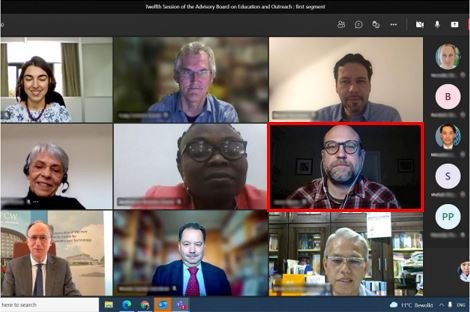
The role of the Advisory Board on Education and Outreach (ABEO) is to provide specialized advice in terms of education and outreach, the development of e-learning strategies, and ensuring these activities are carried out in a coordinated and cost-effective manner.

The United Nations Study on Disarmament and Non-proliferation (2002) education begins by stating:

There has never been a greater need for education in the areas of disarmament and non-proliferation, especially with regard to weapons of mass destruction, but also in the field of small arms and international terrorism…The overall objective of disarmament and non-proliferation education and training is to impart knowledge and skills to individuals to empower them to make their contribution, as national and world citizens, to the achievement of concrete disarmament and non-proliferation measures and the ultimate goal of general and complete disarmament under effective international control.

As noted in the report,

Science and technology transformed the world in the twentieth century. Living standards improved but warfare was rendered more deadly. Weapons of mass destruction -biological, chemical and nuclear - and their means of delivery were developed, as ever more sophisticated conventional armaments were produced and disseminated. The horrors and destruction of armed conflict persist.

And this is Jacques Ellul’s point, exactly, in The Technological Society - we cannot have the good without the bad. As I write this, The Associate Press has reported, “Russia plans to give its nuclear weapons apparatus a practice run this weekend.”

The cynic in my says that education stands little chance in the face of evil, but I have long embraced Camus’s point that if he who bases his hopes on human nature is a fool, he who gives up in the face of circumstances in a coward. To be part of the OPCW’s ABEO is part of that formidable gamble that words are more powerful than munitions. I’ve never been much of a gambler, and when I have bet, I have always lost, but this where I have laid my chips:

High- and low-technology teaching tools and techniques for conveying content, stimulating interest and evoking emotion such as videos, animation, electronic games, theatre, dance, films and the graphic arts such as photography are useful and effective means for presenting the subject of disarmament and non-proliferation as well as concepts such as tolerance, democracy and conflict resolution. (section 27)

Dr. Richard Guthrie, another member of OPCW’s Advisory Board for Education & Outreach, assembled this FAQ regarding chemical weapons and the Ukraine: https://www.cbw-events.org.uk/faqs-ukraine.html

Thanks also to Richard for pointing out the important publications below:

Two publications released last week in the UK may be of interest:

One is a brief report from the House of Commons Library on: "Ukraine: Fears Russia could use chemical weapons" (available at https://commonslibrary.parliament.uk/ukraine-fears-russia-could-use-chemical-weapons/).

The Library is a very useful source of non-party political advice in the British Parliament.  The report has a little bit of a mix up between chemical and biological issues but is useful, nonetheless.

The other is a report from the Royal Society of Chemistry on racial and ethnic inequalities in the chemical sciences (available via https://www.rsc.org/news-events/articles/2022/mar/new-1.5m-unit-to-tackle-racial-inequalities-in-science/).

Pages 39-40 of the report discuss generating a global chemistry community and so may be of particular note to Board members.  This report follows on from the sense of belonging report published last year (https://www.rsc.org/new-perspectives/talent/belonging-in-the-chemical-sciences/).


I hope these links are of use.

Is it a micro-credential?

https://www.mhc.ab.ca/NewsandEvents/Stories/2021/December/MHPS-PatrolSupervisorMicro-credential

In early December, the team and I had the great fortune to work with the Medicine Hat Police Service on MHC’s first micro-credential, a Patrol Supervisor.

The micro-credential emerged because an important element of Medicine Hat Police Service’s (MHPS) Strategic Business Plan 2019-2022 is developing a Patrol Supervisor’s Course that will provide the opportunity for constables interested in acting as a sergeants. The 35-hour learning opportunity was offered in a blended learning format consisting of 14-hours of online training that delivered core course content (such as policies and procedures), complemented by 21-hours of in-person training that maximized interactivity and application of content to real-life police situations (such as high-speed pursuits).

MHPS employs a competency-based management (CBM) approach that focuses on the competencies – the skills, knowledge, or attributes – of successful performance. The focus on CBM matches both the essence of microcredentials and the goal of the Patrol Supervisor Course. The Alberta Microcredential Framework defines a micro-credential as a credential awarded upon the successful completion of an assessment of a particular skill or competency, or cluster of skills and competencies, associated with specific and focused training, and are designed to be beneficial in obtaining employment or meeting on-the-job requirements. But is it really a micro-credential?

The story linked to above details more about the course, but in this short piece, I want to reflect on the growing confusion of what a micro-credential is (and isn’t), and this growing confusion is in my own head. I used to think I knew what a micro-credential is, but I’m not so sure anymore.

Recently eCampus Ontario released Micro-credential Principles and Framework, and the MHPS Patrol Supervisor checks a lot of the boxes. It’s issued by MHC, in collaboration with MHPS, and the competency outcomes are aligned to the competencies of patrol supervisors. It’s transcriptable and endorsed by a partner. But if it falls down anywhere, it is in the Summative Assessment of the micro-credential, which is one of the defining characteristics of the micro-credential - assessment and evidence of learning. Micro-credentials require evidence of achievement of outcomes.

One module within the Patrol Supervisor course is a review of the Moncton shootings. This haunting documentary shows numerous occasions when a patrol supervisor could have made a different decision (such as setting up a containment grid or getting wounded officers to the hospital). By debriefing episodes such as Moncton and asking “What if?” or “What other options were available?” there is hope that if these officers found themselves in similarly chaotic situations, they would make better decisions. There is no way to acquire evidence of the impact of this training. The ultimate hoped-for outcome of the training is that, in the heat of the moment, patrol leaders will make good or better decisions.

In short, the decision-making competency of the patrol supervisor will only be verified in an incident we pray never happens.

Digital Toolcrib - Season 2

After two Digital Toolcrib episodes, Chad and I let this fall off the side of our desks and then people actually asked us when we were going to do more episodes! It’s a smash hit. In response to these 2-3 viewers, Chad and I have recorded three additional episodes of the Digital Toolcrib and two of them feature special guests which makes them a lot more engaging, exciting, and practical.

Barriers Facing Trades & Educational Development

https://youtu.be/dpvWzUkDkwE 

Chad and Jason talk candidly about how the difficulties facing trades education and some of the barriers involved in providing educational development to trades instructors, including how the word pedagogy frightens the horses and various other forms of misunderstanding and intimidation. The dialogue hopefully identifies some ways to break down these barriers so trades faculty and educational developers can talk the same language of student success.

Reflective Journaling in Carpentry?

https://youtu.be/6WW-wk7gwz4

Medicine Hat College’s carpentry instructor Paul Schaan discusses why and how he implemented reflected journaling in Carpentry, including how it teaches the whole person and increases connection between faculty and students.

Backwards Design in the Trades

https://youtu.be/k72vCpclCoM

In this episode, Chad Flinn and Jason Openo talk with Dr. Sally Vinden of Vancouver Island University. Sally is lead author of Strengthening Digital Teaching & Learning for Trades, Vocational, Education and Training Practitioners, and she received BCcampus’s Award for Excellence in Open Education (2020). The episode discusses how backwards design can be used to ensure competencies are taught and assessed within trades contexts.

Multiple realities: Professional development for online contingent faculty in Canadian strategy and practice.

Openo, J. (2021). Multiple realities: Professional development for online contingent faculty in Canadian strategy and practice [Doctoral dissertation, Athabasca University]. http://hdl.handle.net/10791/360

The growth of contingent faculty and the growth of online education over the first two decades of the 21st century have generated an emergent but overlooked subgroup of faculty – online contingent faculty. These twin dynamics have placed the professional development of online faculty in a strategically important position for Canadian postsecondary institutions to mature online education and enhance instructional effectiveness. This two-phase multimethod research study employs Ursula Franklin’s technology as practice (1990) as its theoretical orientation to explore the following research questions: How are online faculty and their professional development represented in current Canadian postsecondary academic plans? How are the professional development needs of contingent online faculty being served by Canadian teaching and learning centres? What gaps, if any, exist between the projected reality of academic plans and the extended reality of teaching and learning centres in Canada? Phase one consists of a document analysis of 17 academic plans from Canadian colleges and institutes covering the current period and immediate future to reveal how faculty development is described and prioritized in academic strategy (the projected reality of the future). The document analysis highlights important strategic purposes of professional development, such as Indigenization and internationalization, but also shows that part-time and online faculty are marginally represented. Email interviews with 12 directors of Canadian teaching and learning centres comprise phase two (the extended reality of experience), and they illuminate the contested space of providing educational development services to online contingent faculty. The findings reveal formidable barriers to providing professional development opportunities to part-time faculty who teach online, but also innovative solutions to meet the needs of part-time online educators in Canada.

The document analysis of academic plans shows that professional development for online instruction was a neglected topic pre-pandemic, and the email interviews demonstrate that professional development for online instruction became the central, all-consuming task for educational developers, spurring unprecedented creativity and innovation. But it also shows that part-time faculty and their unique needs were again lost in the mix. Part-time faculty have been called indispensable but invisible, and part-time online instructors have been dubbed the doubly invisible. If it is actually possible for a group of people to be triply invisible, the pandemic added this layer of invisibility because it was difficult to determine how much attention was paid specifically to contingent faculty who teach online and their unique conditions.  

This work attempts to dissipate this fog by grounding its orientation in Ursula Franklin’s The Real World of Technology (1990), where Franklin defines reality as “the experience of ordinary people in everyday life” (p. 36). The professional development for part-time online instructors is not something I explore from a distance. I know this challenge intimately; this has been the nitty gritty of my day-to-day life for the past several years. My efforts to make sense of this tricky terrain have been guided by Franklin’s concerns about how technology affects the quality of our lives, and I hope this work embodies her spirit to solve problems and make the world a better place by employing her concept of redemptive technologies that can arise during a convoluted and tumultuous time such as this one.

Solar classroom shines light on renewable energy

MHC Brooks Campus EBSCO Solar Classroom 1..JPG

On Wednesday, September 8, I had the opportunity to participate in a small ribbon cutting for the new solar classroom built at MHC’s Brooks Campus, right outside the Brooks campus library. I was the lead author on the successful 2019 EBSCO Solar grant application, and MHC was the first Canadian library to be selected for a grant that helps make a critical impact on improving the environment and helps libraries make the transition to green power.

https://www.mhc.ab.ca/NewsandEvents/Stories/2021/September/SolarClassroom

The major selling point of our grant was student involvement. Clay Bos, Peter Kelly, and James Kuehn designed teaching and learning experiences for MHC’s Built Environment & Engineering Technology (BEET) students. BEET students developed initial concept ideas and designs and build the Request for Proposal (RFP) that went out to tender. Terralta and Brost Developments were selected in large part because they built the classroom with learning opportunities built in from start to finish.

In the scheme of things, it is a small grant and a small project with big vision that generates a bit more energy for transformative change.

MHC Brooks Campus EBSCO Solar Classroom 2.JPG

The EBSCO Solar grant allows us to expand our historical commitment to SE Alberta and extend our traditional role into new areas. MHC’s libraries, at both the central and Brooks campuses, are people attractors, and the Brooks campus solar classroom will attract designers, researchers, and students. It would serve as a wonderful band stand for outdoor concerts or events at a time when we are encouraged to spend more time outdoors because of COVID and because time in nature is good for our mental health.

It’s also an example of how I like to work - finding ways to collaborate in meaningful ways that make big visions real.

A major component of Brooks' sustainability plan is to Create A Built Environment in The City that Is Environmentally Friendly and More Energy, Land, and Resource Efficient. "New developments and renovations in the City of Brooks should strive to be as environmentally friendly as possible. The built environment should reflect ideals in energy efficiency, water/wastewater management, renewable energy systems, land conservation, green technologies, and community connectivity." The addition of the solar classroom into the built environment reflects this commitment at the same time it piques curiosity. How much power is being generated? Could I do this in my own backyard?

I hope MHC’s students at the Brooks campus and Brooks community members can find creative ways to use this space in the days and years ahead.

Higher Education After the Pandemic

Carr - Technology and Education.JPG

On March 13, I had the delightful opportunity to talk with Peter Carr at the University of Waterloo about an article I wrote for the Canadian Journal of Learning and Technology.

https://impactofinformationsystemsonsociety.wordpress.com/2021/05/13/higher-education-after-the-pandemic-jason-openo/

The interview covers why I am changing my mind about the article I wrote, how to create more interactive online learning experiences, the need for more authentic assessments, and the various institutional constraints for achieve higher-quality online education.

Digital Toolcrib

DigitalToolCrib.png

Recently, Chad Flinn (Dean of Trades & Technology at Medicine Hat College) and I started a podcast to support Trades and Technology instructors at MHC, but the episodes might have a broader appeal to other educational developers and trades faculty interested in Technical Vocational Education & Training (TVET).

Episode 01 - Assessment in Trades and Technology

A lot of trades students come into the trades with a negative history and relationship with schooling, many being told they were smart enough to do anything but go into the trades. Most trades are also governed by a body that requires high-stakes summative exams. This has huge and important implications for how trades instructors prepare their students for these exams and go beyond these exams in their assessment strategies. This episode explores some of the challenges and new opportunities for rethinking assessment in the trades.

https://share.transistor.fm/s/539291b6?trk=public_post-content_share-embed-video_share-article_title

Episode 02 - What worked and what didn’t

If we could go back to February 2020 before the pandemic (not that anyone would want to live through the past year again), and ask trades instructors what they would say if we told them that they would be teaching predominantly online for the next year, the answers probably would have included at least a couple expletives. But it happened. What can we learn from it as we approach the future of trades education?

https://share.transistor.fm/s/255cd8e8?trk=public_post-content_share-embed-video_share-article_title

Hyflex: The best (or worst) of both worlds?

A director of a Canadian teaching and learning centre described hyflex in the following way: "Hyflex sounds sexy, but it's like beer-goggle sexy. When you soberly look at the costs and the pedagogical challenges, it's far less attractive."  

The pandemic has intensified interest in hyflex (hybrid-flexible) learning modalities, but the idea was developed by Brian Beatty in 2006. Hyflex learning environments offer synchronous instruction to both face-to-face and distance students. To paint the prettiest picture of hyflex, all learning activities address and support learning outcomes regardless of the delivery medium, affording students flexibility and freedom. In a hyflex offering, a student could choose to attend class in the face-to-face environment, remotely through their computer, or watch a recording so that the learning objectives and results remain equivalent.  At its best, hyflex provides learner choice and enhances accessibility. 

But making the learning experience equivalent for the student learning at a distance is the primary challenge.  When the instructor is physically present with other human beings in the same space and time, the natural inclination is to favour the in-person students, which is why some recommend building a hyflex course as if it was an online course.  To bridge the gap and make the distance student more present, the physical hyflex classroom is often equipped with several, large video screens, ambient microphones and 360 degree cameras so that the instructor and the remote students can be virtually "face-to-face" with the other learners present in the classroom.  This increases the technological complexity of the learning experience and increases the cognitive load for the instructor. 

Faculty cannot just walk in the room and teach the way they did before. They will be running an in-person classroom AND recording a videoconferencing session.  The instructor needs to plan for content and student learning activities. Lectures should be relatively short (15-20 minutes), engage the learners with generative learning activities (utilizing small breakout groups AND breakout rooms), and employ authentic assessments to evaluate student learning.  

It’s still too early to tell what permanent changes will result from the pandemic, but that is becoming apparent is the many instructors have changed their approaches to shorter, more engaging video lectures and fewer high-stakes exams, encouraging both group discussion and collaboration.  Recent research suggests that, as a result of these pandemic-related adjustments in course design and teaching approaches, students might be studying harder, leading Richard Arum (co-author of Academically Adrift) to say that the pandemic’s big lesson is, “When you move to more engaging, participatory, interactive instructional strategies, student academic engagement goes up.”

Implementing effective active learning strategies presents challenges for many faculty, and low interactivity is a known failing of many online learning opportunities.  Creating active/interactive learning experiences for students learning both in-person and at a distance is a formidable challenge 

Personally, I am not yet sold on hyflex. Online learning (when it is freely chosen and not forced upon us by a pandemic) has enough evidence behind it to show that it can offer high-quality learning experience when intentionally designed with the distance learner in mind.  Face-to-face learning experiences facilitate the construction of a well-connected learning community more easily. 

But here's what I know. Several other institutions are exploring hyflex learning and spending lots of money through classroom transformation projects.  As several other technological implementations and adoptions have shown, over time, some institutions and their faculty will figure out how to do hyflex well, and those that do will be able to offer academic opportunities that increase competition in the marketplace. That’s the most sobering thought of all, and the best reason to experiment to see how hyflex can work at MHC.

Thank you to Rene Hemenway and Michael Pin-Chuan Lin for helping provide background research for this article.

HyFlex Learning with David Rhoads - Teaching in Higher Ed Podcast

Hybrid-Flexible Course Design: Implementing student-directed hybrid classes by Brian Beatty

What To Expect In A Hyflex Course: Faculty Handbook by Texas A&M San Antonio

HyFlex Course Design Examples

High Enrollment and HyFlex: The Case for an Alternative Course Model